Happy Friday! I hope you’re gearing up for a great hockey weekend, getting started with this week’s Playbook.
With two English teams qualifying for the last 8 in the Men’s Euro Hockey League I’ve been following the games with some extra attention the last few months and a few themes have emerged for me.
The first one is that now more than ever, dragflicks with speed into the bottom corners seem to account for so many goals! This is maybe worth diving into in a subsequent email all of its own but just the execution of low flicks to the corner seems to be at an all-time high — ‘Bottom Bins’ are definitely the new ‘Top Bins’ when it comes to converting corners. This may have always been the case, we are seeing many of the top teams really mastering it at the moment.
However it is the other theme around goal scoring that I wanted to write more about today. And that is ‘Back Foot’ shooting. With space always at a premium in the circle the advantages to developing a reliable & quick back foot shot are considerable.
When rewatching Old Georgians’ (Eng) thumping win against HC Olten (Sui) in the last 16 of the Euro Hockey League there was a 10 minute spell where OGs scored twice and hit the crossbar all from players swiveling on their back foot and smashing the ball at goal in one fluid motion.
We’re going to look at all three sequences in reverse order as I think each one showcases a different benefit of this particular finishing technique.
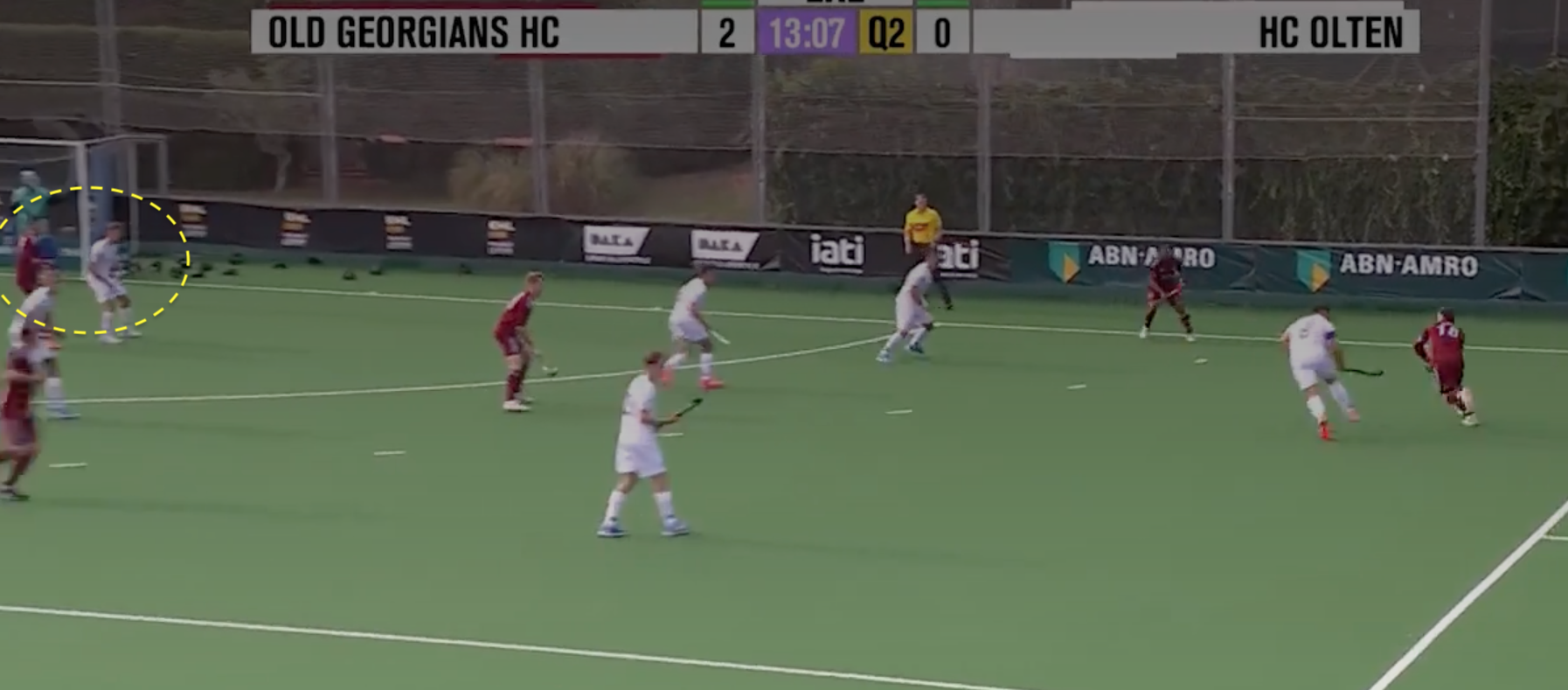
Here we see the ball carrier on the right wing and the OGs centre forward Alan Forsyth being tightly front marked in the circle, so far this is a decent defensive structure.
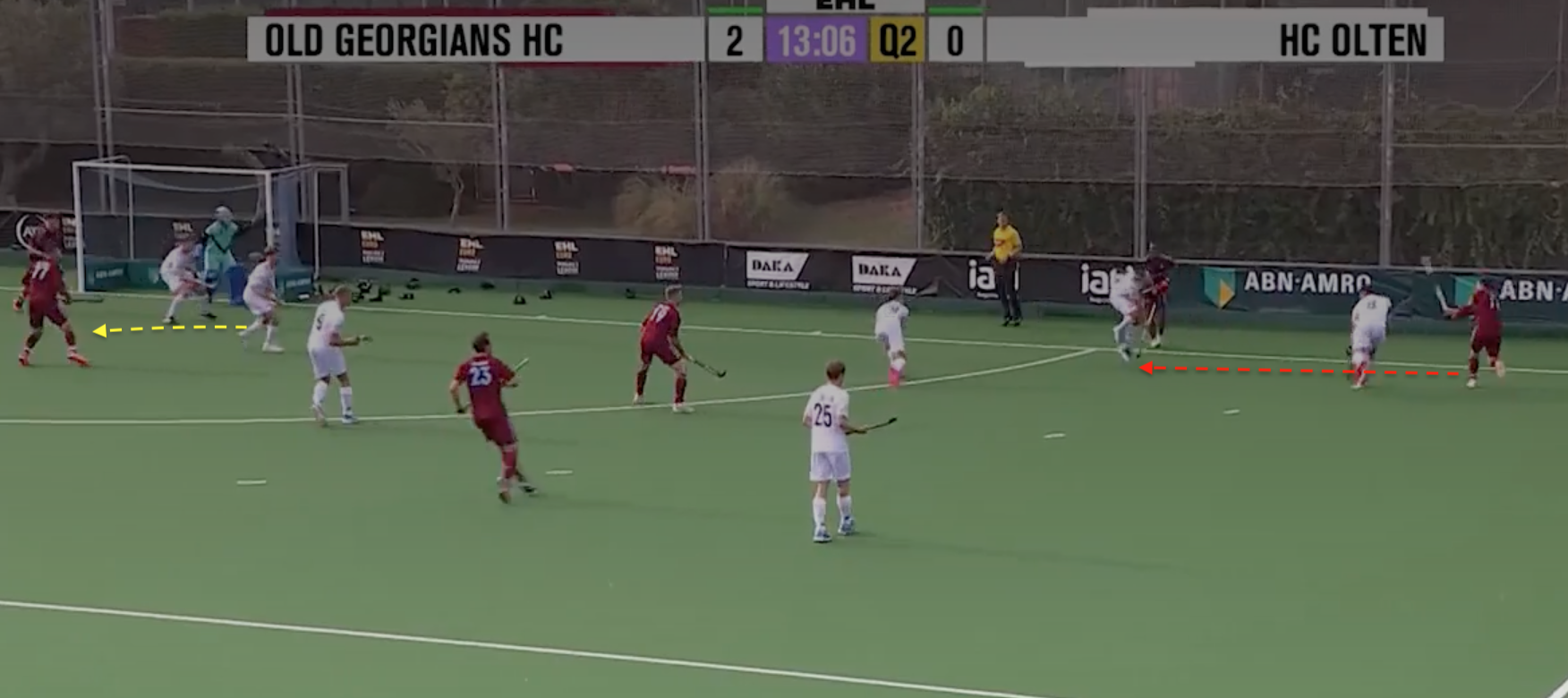
But as the ball is crossed into the circle (red arrow) he makes a very clever 2/3 yard lead backwards away from goal and more importantly, the defender. Because he is being front marked, the defender does not see this immediately.
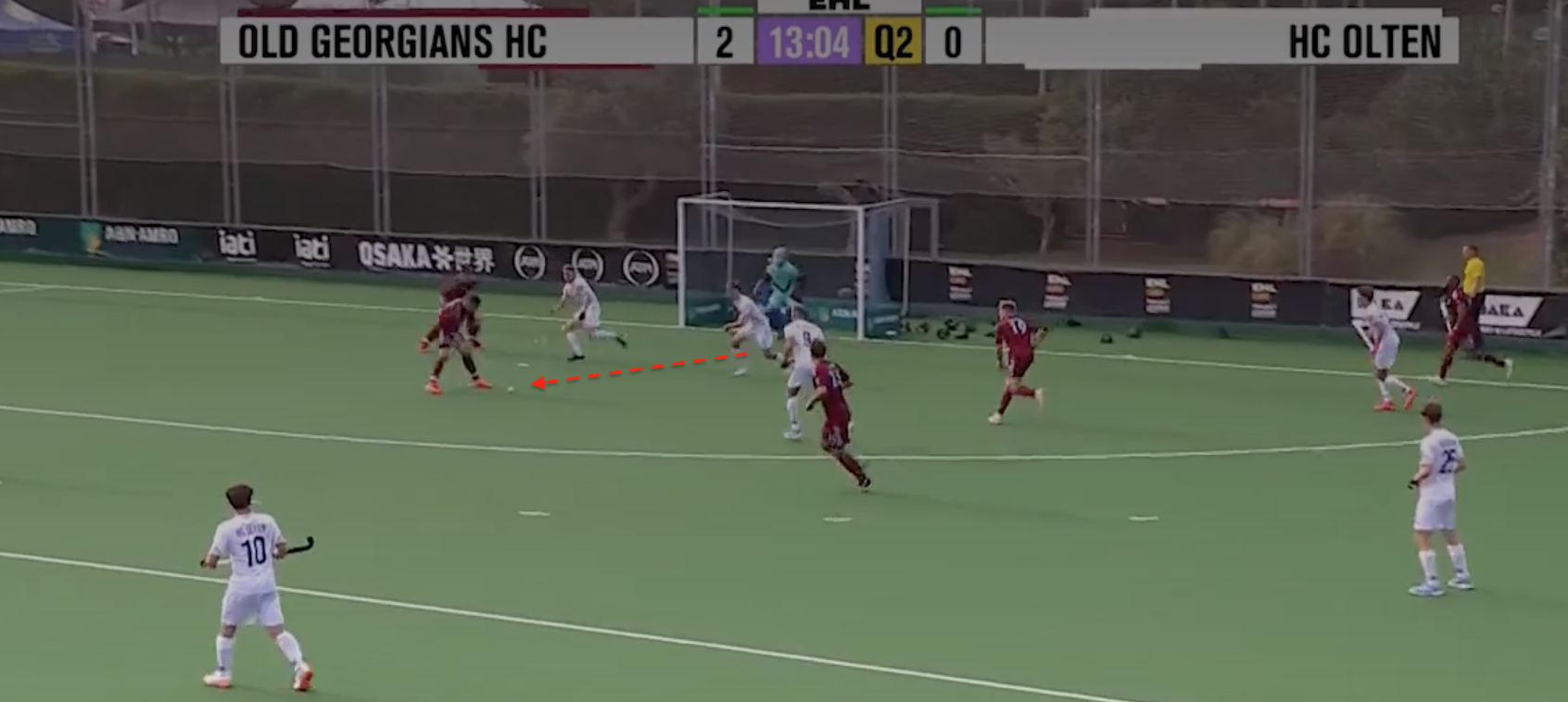
The ball deflects back from a defender’s stick as it comes across the circle and rolls perfectly back towards Forsyth’s right foot — and there is only one result from here — GOAL. Yes some fortune with the direction the ball was deflected in, but this is the reward for moving away from goal in the circle. Many times a defender is concerned with the area around the goal and so will not follow you out. This type of lead generates space for a back foot shot very consistently.
The 2nd shot of the sequence from Chris Proctor ended up hitting the crossbar but shows us a way of creating space and protecting the ball in one move that is very valuable in the circle.

The ball deflects off a defender straight towards Proctor. Many less experienced players in this situation would immediately try to push the ball back towards goal, but the defenders & keeper are right behind the ball and would likely stop/save it.
Instead he let the ball roll past his left foot, then spins strong on his forehand, around and away from the defender, creating space back towards goal.

From here he uses back space, again away from where the defenders are moving, and ends up in this shooting position (this is a different camera angle). It hits the bar, but his movement into the backspace creates a much better scoring opportunity.

Lastly, we’ll look at the first goal scored in this match sequence, from Henry Croft. Rewatch the match clip here, because you want to see the video of this one to appreciate it!
Croft finds space in a left channel as the ball is being carried down the left baseline.
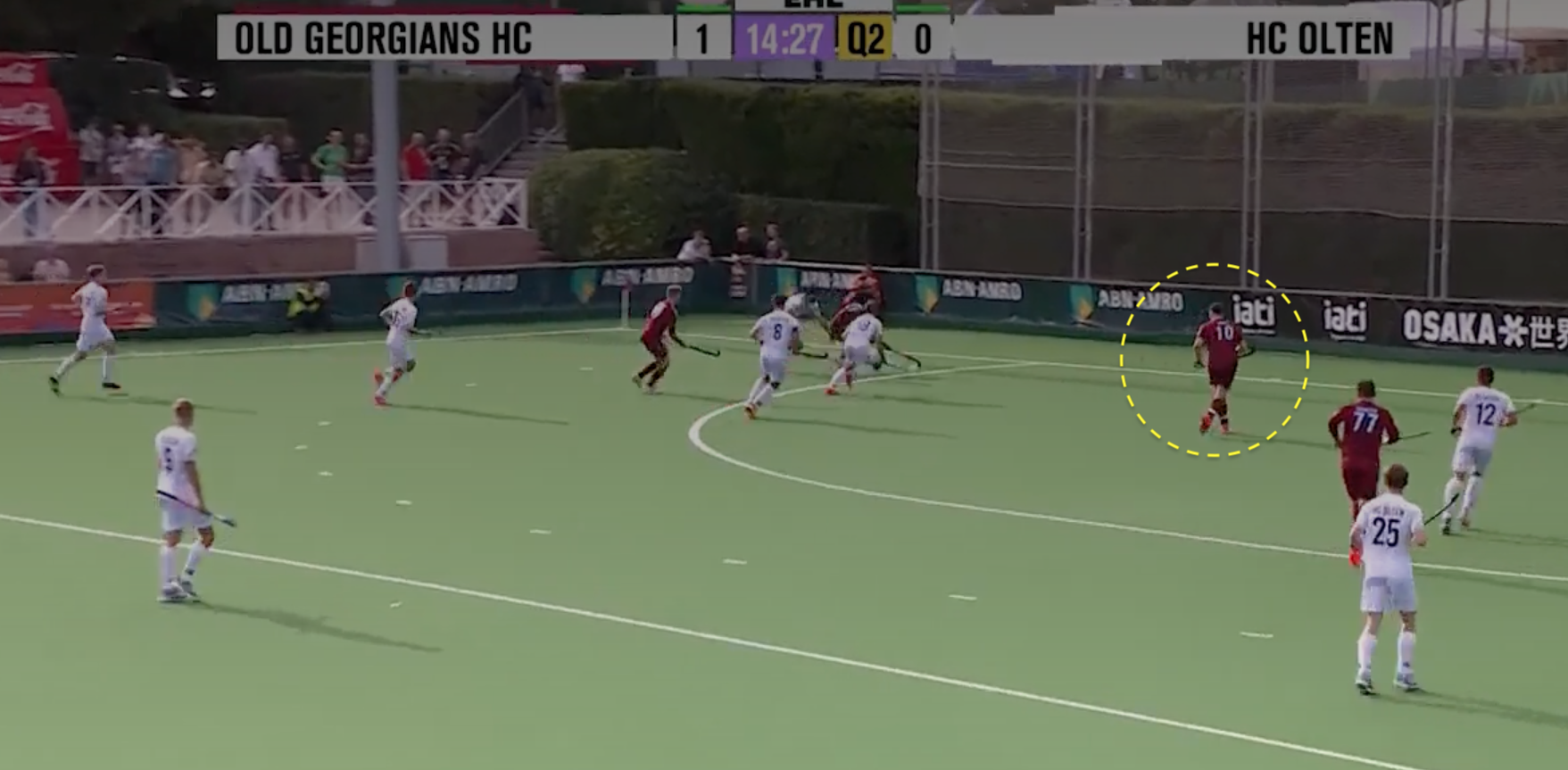
As the ball comes into him Croft uses a textbook wide base receive to protect the ball and retain possession under lots of pressure from his marker.
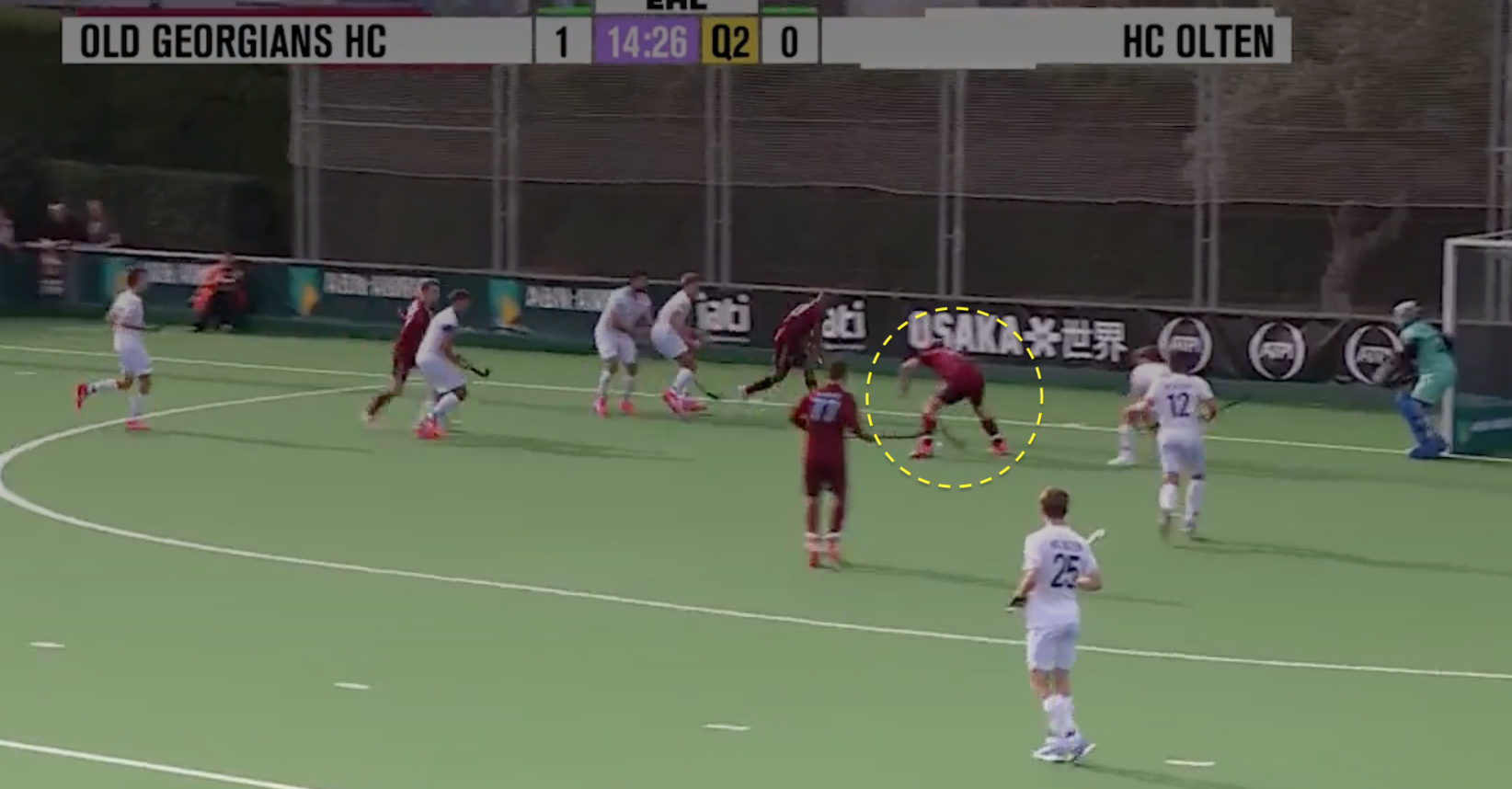
From this position the ball never really leaves his body space which is the real key to world class execution. Croft pivots 180 degrees on his left foot while making a back swing, and then as soon as his body is turned toward the goal he makes contact with the ball. A vicious finish that left the goalkeeper with absolutely no chance.
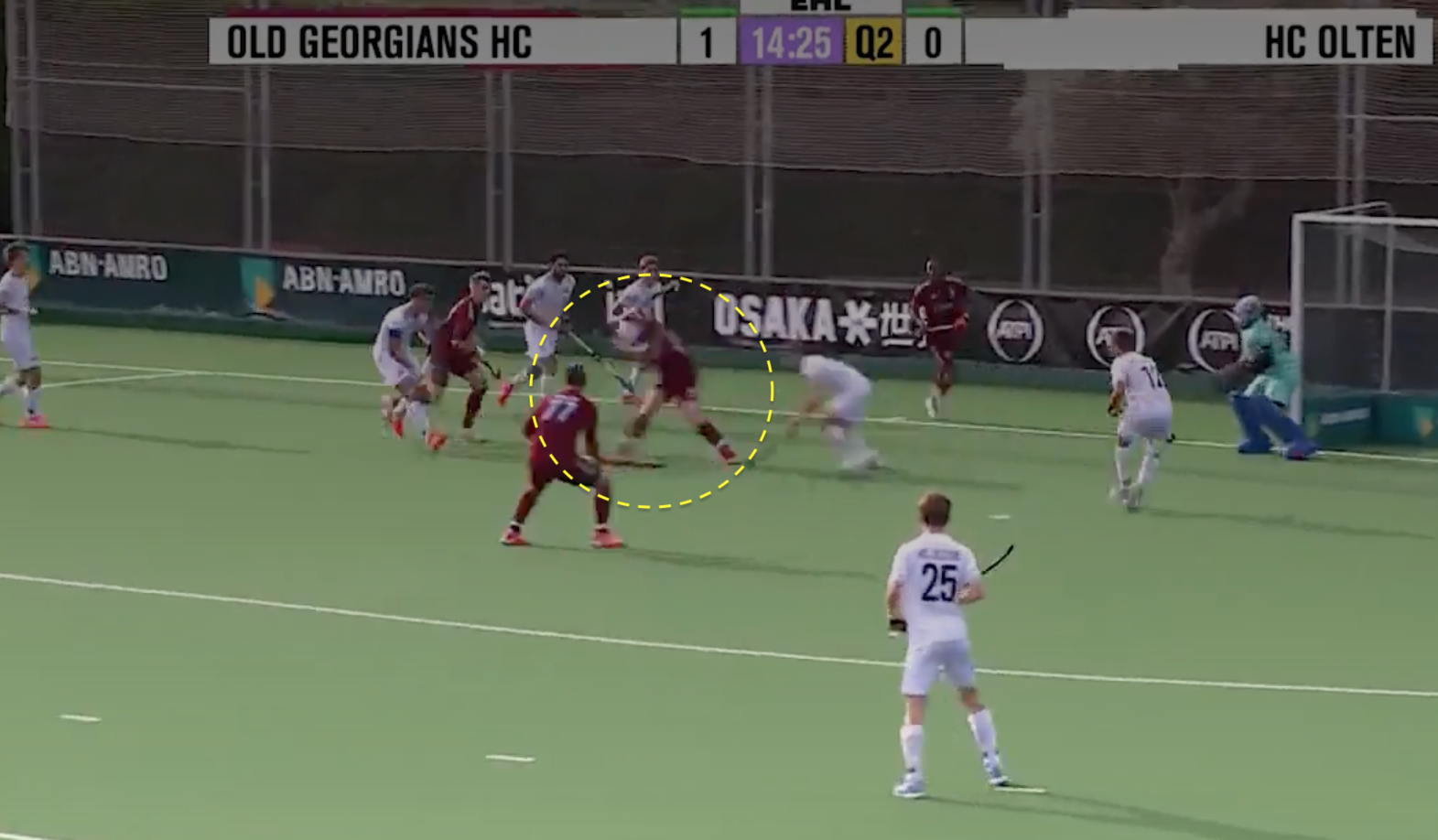
Apologies for the blur on the images, but I really suggest watching through on the video here.
Keeping the ball within his body space the entire time makes this type of finish almost impossible to defend and if you can add it to your game, I promise you’ll score A LOT more goals!

Hi Adam,
It’s working!!!! Thanks for doing what you do. To Ross, too. Our girls are beginning to really apply their skills to the game & it was really evident this weekend. Everyone comments on their skills and I tell them it happens thanks to Leap & in our basement or messy toy room.
Just so grateful for this service that Leap provides as it makes field hockey much more fun for them!!