Happy Friday! I hope you’re gearing up for a great hockey weekend, getting started with this week’s Playbook.
And this weekend is an especially great hockey weekend because it is EHL (Euro Hockey League) Finals weekend. For our American audience, this is as close as you’ll get to March Madness—but for field hockey. Most of the best players in the world competing for Europe’s biggest trophy.
There are some TV deals in place in Belgium, the Netherlands, and Latin America, but everyone else can watch every match live or on-demand, plus highlights, at https://www.eurohockeytv.org/ for only 16 Euros. This is some of the best money a hockey player/fan can spend all year, in my opinion.
Watching the best players play is something too many young players are missing out on. Yes, too much screen time is bad, but not all screen time is equal. If you’re going to be watching something this weekend, pause your shows and watch some of the best field hockey on offer.
To be clear—we have zero commercial relationship with the EHL. I just think watching this stuff is super valuable for developing as a player.
For context, I’m writing this on Thursday, April 2nd—one day before you will read this—so some other results will have been decided by then, but here is a quick summary of what has happened so far.
Wednesday, 1st April
This was the Women’s Round of 12 matches—so the top four teams got a bye in this round to the Quarter Finals, and then eight teams played four matches to see who would join them. The top four teams with a bye were:
Then the results from the 4 qualifying matches for the Quarter Finals were:
Some interesting things to note from these matches: this was Watsonians HC’s debut in the competition, so congrats to them on making it at least to the Final 8 at the first time of asking. Railway Union was only their second appearance, so some real progress from Scottish and Irish women’s hockey in the last few years.
Thursday 2nd April
At the time of writing, there have already been two matches completed in the Men’s Final 8—and not good viewing for an Englishman 😭
Both English teams losing 3-1 in their Quarter Final match ups.
After what has been an unusually long introduction, it is this final match—Gantoise vs Old Georgians—that we are going to dig into today to see what we can learn.
The pattern I picked up while watching this game was an attacking concept that I, as a coach, have been focusing on more this season, so it was interesting to see the idea executed at the highest level. As with many great concepts, it’s very simple:
To score more goals, get in between the posts.
Now, as with the Gantoise match we profiled last week, this result was hugely impacted by the penalty corner brilliance of Alexander Hendrickx, who scored another brace of drag flicks. Albeit, he did miss out on another hat-trick by having a penalty stroke saved by OG’s goalkeeper, James Mazarelo.
But when looking at the open goals and big scoring chances within this game, we see many examples of the concept above.
You can watch highlights at the link below at no cost—although you will need to create an account on the site:

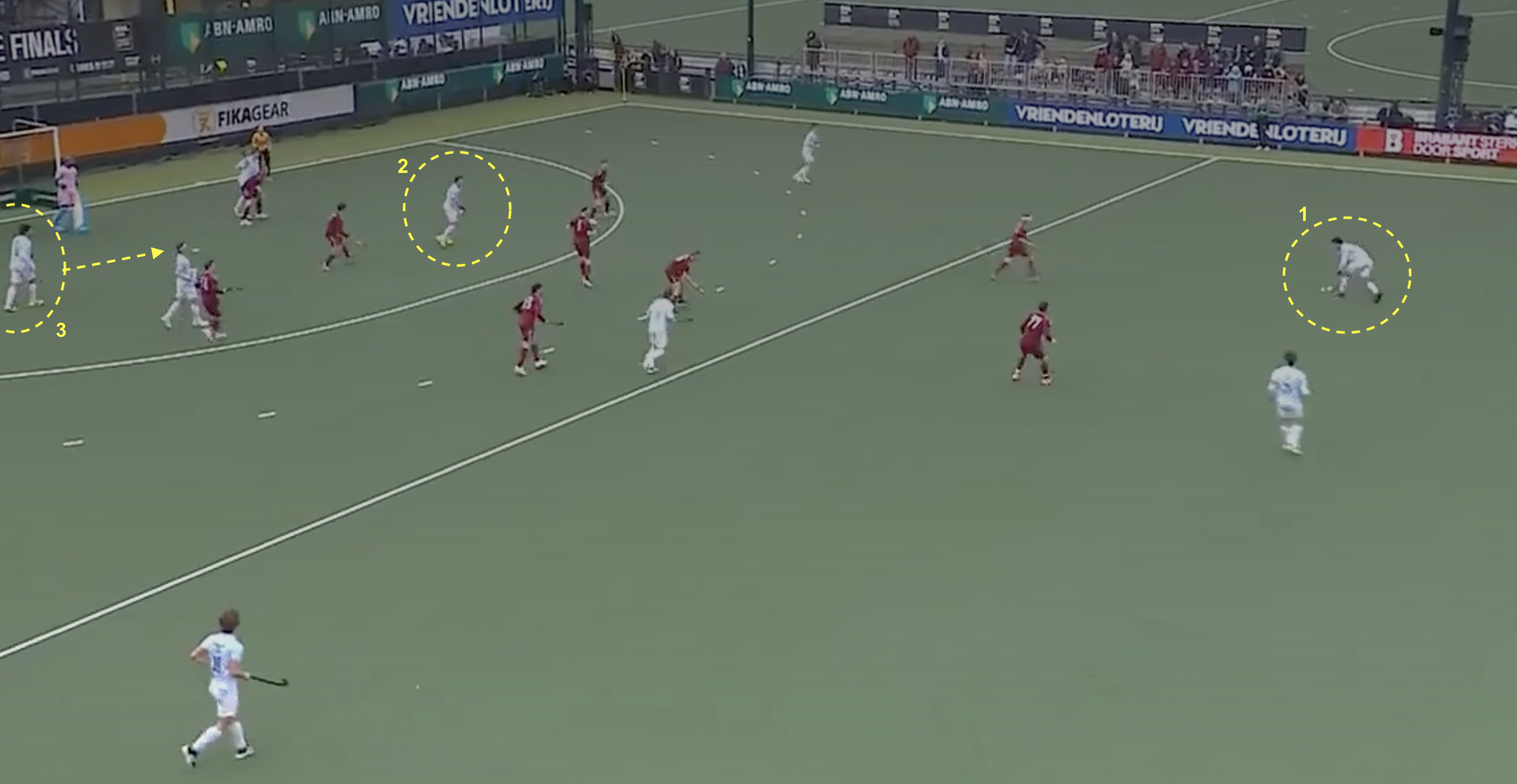
Gantoise’s first and only open goal of the match is example #1. The screenshot below shows us the build-up to the goal, with Gantoise in high settled possession. I have circled the player with the ball (1), and then two forwards (2 & 3) who impact the play.
Player 2 is on the line between the ball and the goal (in between the posts), and Player 3, Roman Duvekot, is moving towards the posts—but importantly at a different height in the circle, closer to the goal.
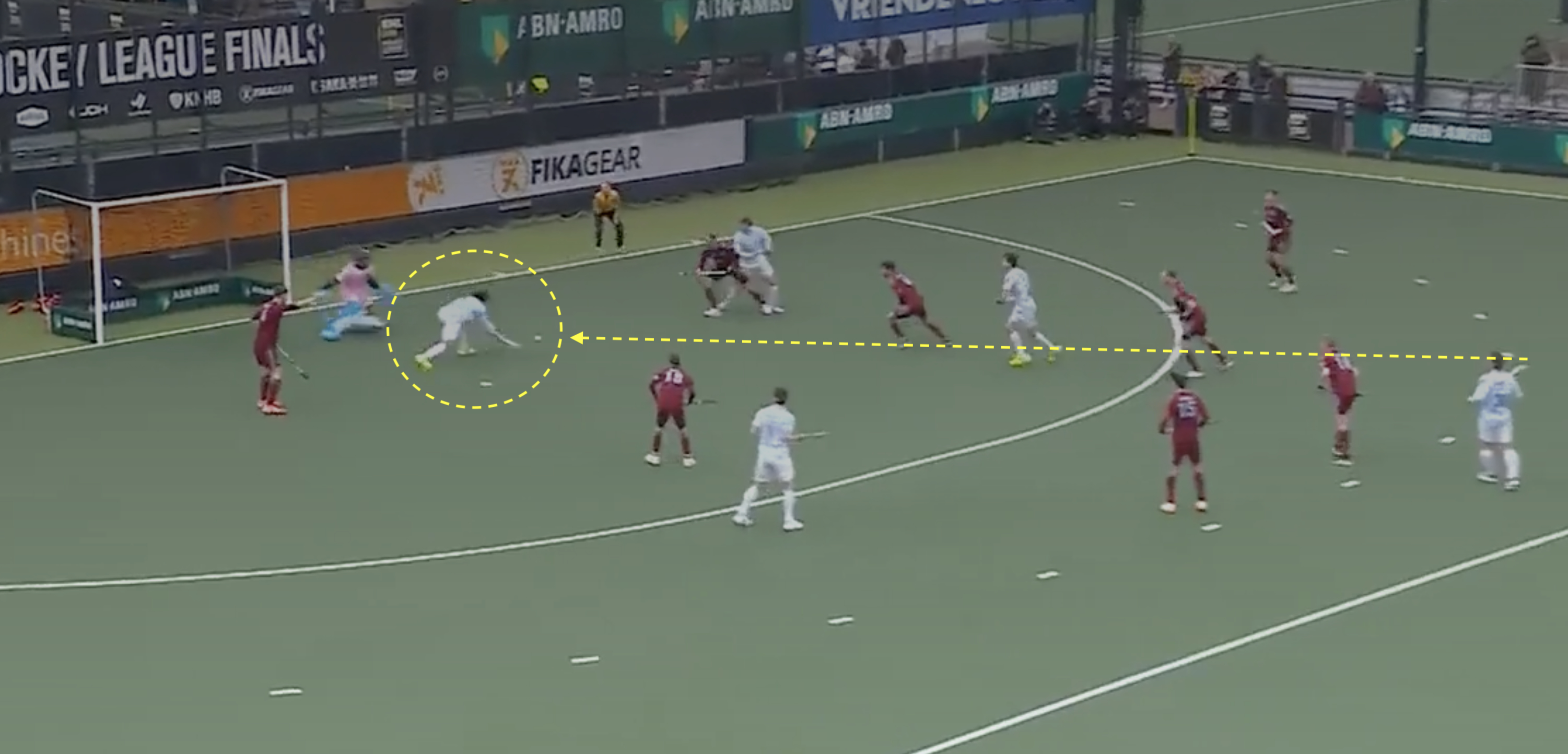
Now we see a screenshot from just before the goal is scored. The ball is played directly into the circle with speed, on a line to goal (often a very good idea to create chances). Player 2 from above disrupts the defenders on the edge of the circle, then deflects the ball through. Now we see Roman Duvekot (Player 3 from above) has moved between the posts and is left with a simple finish.
Gantoise then doubled their lead with Hendrickx’s first from a penalty corner. The next chance we see is example #2.
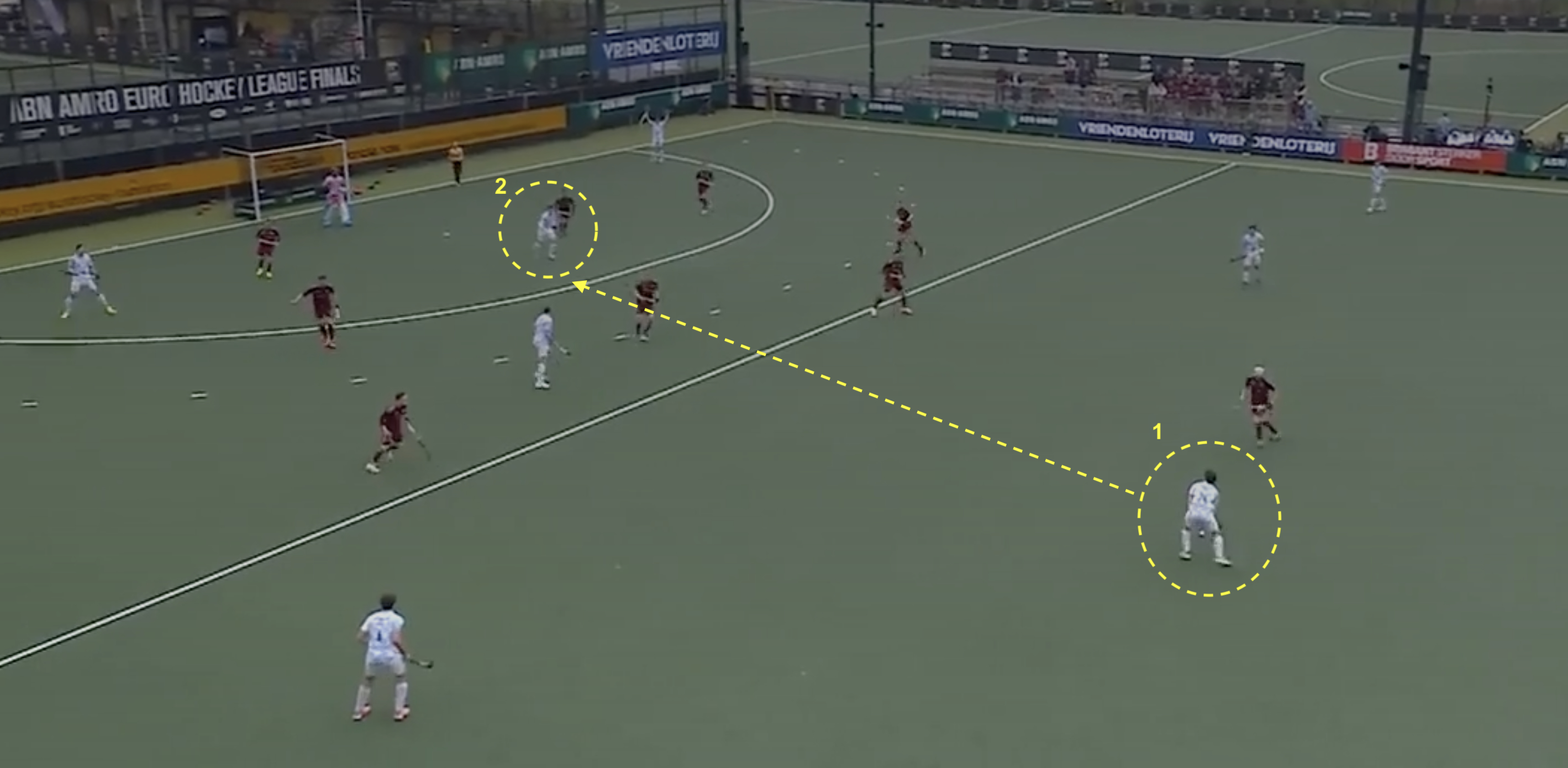
This is very similar. Again, Gantoise are in high settled possession, and Antoine Kina (Player 1) plays another fast, direct ball into the circle, straight at goal. This time it’s Nathan Rogge (Player 2) who is taking up the important position between the posts at the top of the circle. Kina’s pass makes it through, and a simple deflection from Rogge produces a great save from OG’s goalkeeper, James Mazarelo.
Another corner from Hendrickx gives Gantoise a 3-goal lead, and then their next big open play chance is our third example.
Sean Murray (Player 1) this time wins the ball in the press high up on the right, so Gantoise are now in a fast transition attack rather than a slower build-up. Nevertheless, we see similar principles play out. Player 2 supports very well inside, but what is important is Player 3—Thomas Vandergrascht’s position/lead never strays out of the posts. He gets higher but retains his position between the ball and goal.
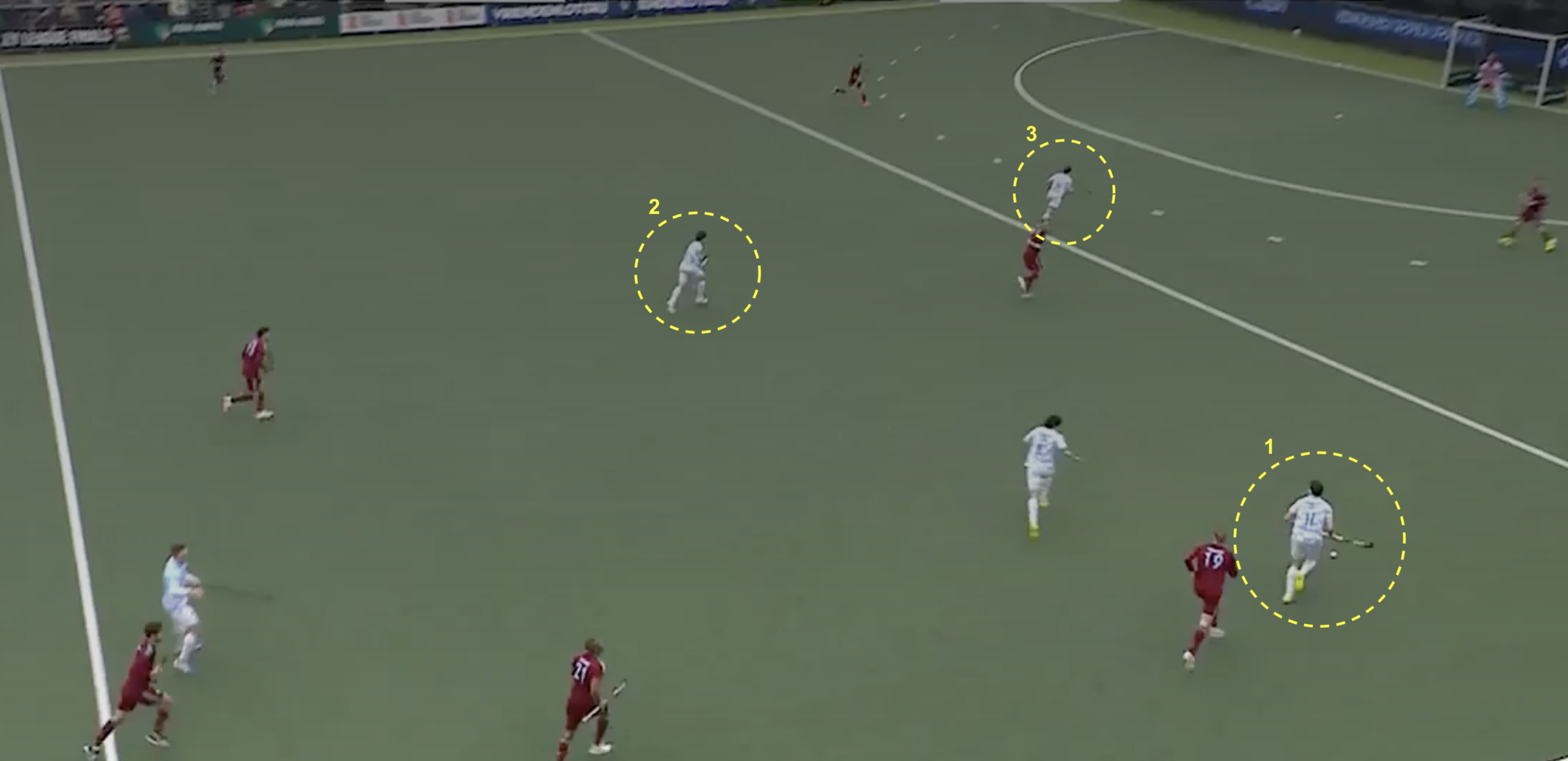
As the move plays out, Murray slips the ball inside, and another direct pass toward goal gives Vandergrascht (circled below) a great deflection opportunity. Again, James Mazarelo makes an unbelievable save to deny a goal.
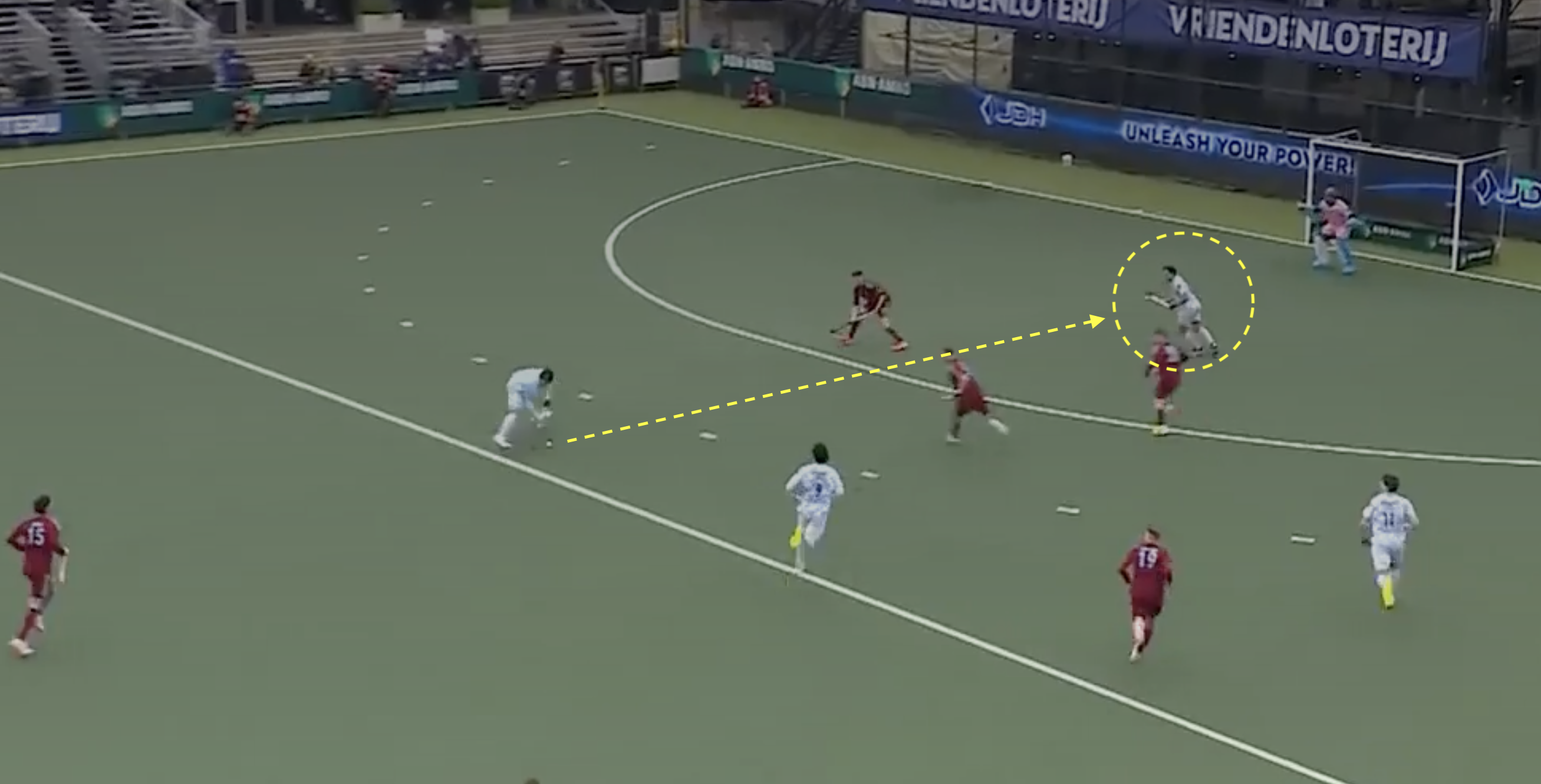
But for the incredible performance by Mazarelo, Gantoise would have scored two more goals from this pattern: direct, fast passes into the circle, straight at goal, with smart movement from their forwards to ensure there is always someone directly between the posts.
Notice this was not the same player—so it’s an obvious team principle that someone in the forward line always needs to occupy this space. The fact it is different players makes it even harder for the defenders.
A remarkably simple idea—and yet you’d be surprised at how many attacks unfold in a game without this simple positioning in the forward line.
If you want to score more goals, make sure you have someone in between the posts.
Watch the EHL Finals this weekend!!!

Hi Adam,
It’s working!!!! Thanks for doing what you do. To Ross, too. Our girls are beginning to really apply their skills to the game & it was really evident this weekend. Everyone comments on their skills and I tell them it happens thanks to Leap & in our basement or messy toy room.
Just so grateful for this service that Leap provides as it makes field hockey much more fun for them!!