Happy Friday! I hope you’re gearing up for a great hockey weekend, getting started with this week’s Playbook.
This week’s topic is one that I, and I imagine every player, parent and coach, wrestle with at some point:
Are we training too much… or are we actually not training enough?
Because if you listen to most conversations around injuries in sport, the conclusion tends to feel quite straightforward.
Train too much and you get injured
Train less and you stay healthy
But while reading a very interesting book this week, Built From Broken by Scott Hogan, I realized the reality is much more nuanced than that and, in some ways, completely counterintuitive.
It’s a great book which I fully recommend to anyone struggling with injury and while diving into it, I came across some fascinating research by Dr Tim J Gabbett from the School of Exercise Science, Australian Catholic University
Here’s the central idea that really stood out to me:
The players who train more are often actually less likely to get injured.
Now at first glance, that feels like it shouldn’t be true, but when you understand the research, it starts to make a lot of sense.
The research shows that while higher training loads can absolutely increase injury risk in the short term, higher chronic training loads—what a player has built up over time—can actually have a protective effect. And perhaps most interestingly of all, there is also strong evidence that under-training can increase injury risk as well - see the graph below.
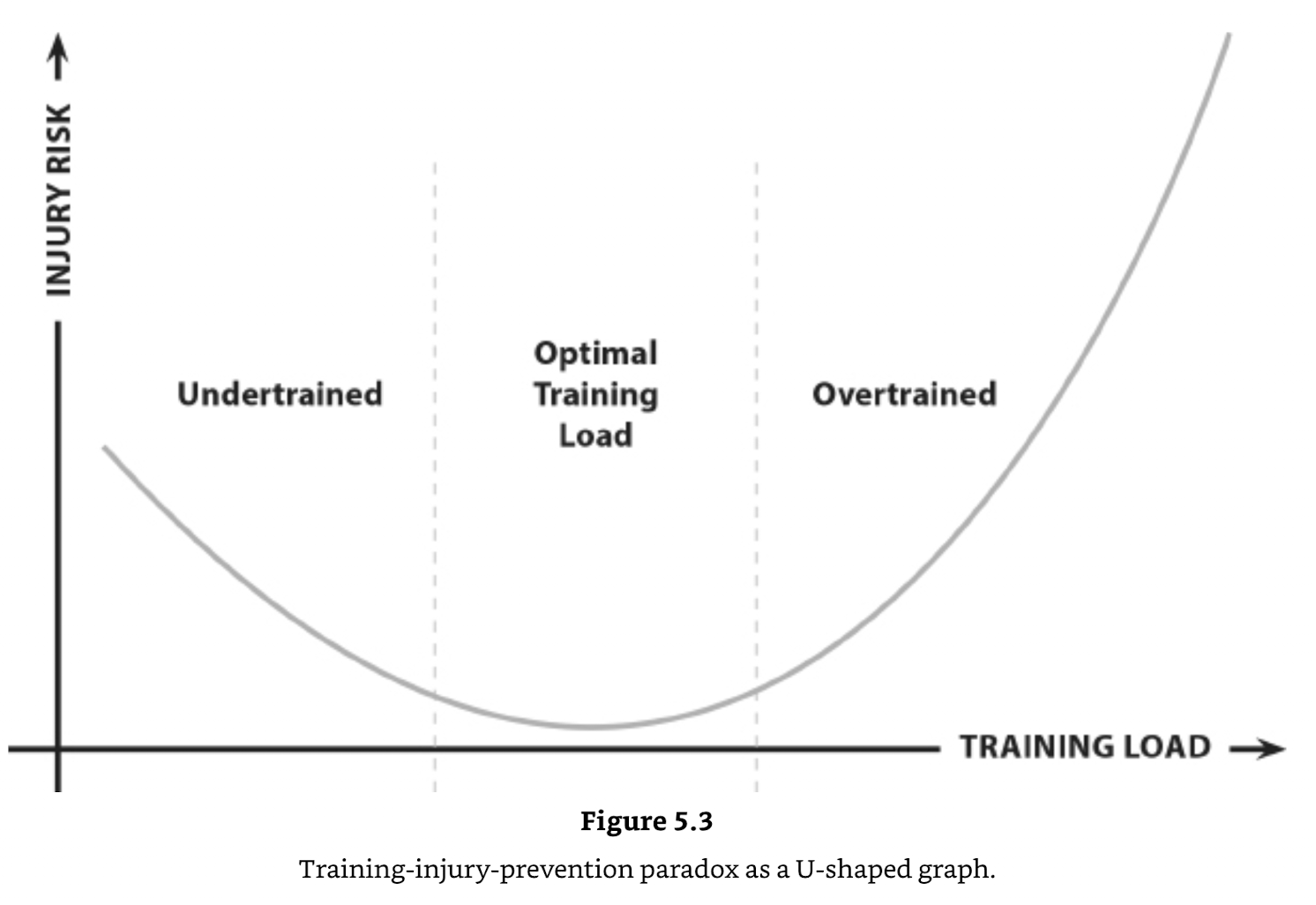
So this idea that we should simply “do less to stay safe” needs to be more readily questioned.
I think a good way to understand this is to recognize that training is always doing two things at the same time.
On one hand, it creates fatigue in the short term, which can increase your immediate risk. But on the other, it builds fitness, strength and resilience over the long term, which reduces your risk.
The mistake many players and teams potentially make is focusing too much on the first part.
When players are well-trained and physically prepared, they are simply much better equipped to deal with the demands of the game. They can tolerate higher intensity, they recover more effectively, and they are far more resilient in those chaotic, unpredictable moments that often lead to injury.
In simple terms, and this is really the key takeaway here:
Fitness protects you.
One of the most important ideas in this research, and one that I think has huge practical implications, is this:
It’s not high training loads that cause most injuries—it’s sudden increases in training load.
When players:
That’s when problems tend to occur.
In fact, even relatively small increases in training load can lead to large spikes in injury risk if they happen too quickly.
So it’s not really about how hard you train—it’s about how well your body has been prepared for that level of training. And this, of course, does not simply apply to training, but probably even more importantly to the competitive match environment.
If the training and preparation load/intensity does not replicate what players are likely to experience during weekend matches or a tournament they are working towards then that is when the injury risk starts to really escalate.
I was lucky enough to be in the audience for a presentation by one of the best hockey coaches in the world Allison Annan. She took us through her preparation strategy for the Netherlands Women’s team en route to Olympic Gold.
She calculated the total distance she thought each of her players would need to run during the Olympics in order to win Gold, two years before the event, and then designed the entire preparation process, weekly loads and distances to replicate this.
So if doing less isn’t the answer, and doing more isn’t automatically the answer either, what are we actually aiming for?
The research describes what we might call a “sweet spot”—a range where training is high enough to drive improvement, but controlled enough to avoid unnecessary risk.
When players stay within this range, they tend to build fitness steadily, reduce their injury risk, and most importantly, remain consistently available to train and compete.
Step outside of it—either by doing too little or increasing too quickly—and that’s when issues start to arise.
A Simple Way to Think About It
If we strip all of this back to something practical, I think there are three really useful principles for players:
If you’re a player, I think the key message here is not to shy away from hard training, but to make sure you’re prepared for it. The goal isn’t to avoid load, it’s to build towards it in a smart and progressive way.
And if you’re a coach, the takeaway is similar. It’s not simply about reducing training to keep players safe, but about carefully managing how that training builds over time, so that players become more robust rather than more vulnerable.
Because ultimately, we’re not trying to protect players from the game—we’re trying to prepare them for it. One of my favorite ideas from this research was the suggestion that training, when done properly, can actually act like a kind of vaccine against injury .
Expose the body to the right level of stress, in the right way, over time… and it adapts. It becomes stronger, more resilient, and better prepared for the demands of competition.
And in the long run, that’s what keeps players both improving—and on the field.

Hi Adam,
It’s working!!!! Thanks for doing what you do. To Ross, too. Our girls are beginning to really apply their skills to the game & it was really evident this weekend. Everyone comments on their skills and I tell them it happens thanks to Leap & in our basement or messy toy room.
Just so grateful for this service that Leap provides as it makes field hockey much more fun for them!!