Happy Friday! I hope you’re gearing up for a great hockey weekend, getting started with this week’s Playbook.
Ok let’s dive into my slightly ambiguous title here. This idea came to fruition after watching the recent shootout in the FIH Pro League between the Australian and Indian men’s teams. It was a close affair with Australia edging the affair 5-4. I like to pay attention to Shootouts because I think it gives us a great insight into the types of elimination skills that really work! Those that hold up under-pressure and work consistently and repeatably even against a player who has far more defensive tools than a normal defender (the Goalkeeper). If a certain movement or pattern works consistently against a Goalkeeper, in this setting, then it is a fair assumption that it will be very effective in open play. And therefore something we should consider in our training and session planning.
While watching the shootout in question, the following goal by Jack Welch really caught my eye. It felt different to the other eight. Something about it resonated with my eye. It felt smoother. More inevitable. More impressive. It’s a personal thing I guess, but this goal connected more with what I love about hockey but I wasn’t immediately sure why.
So, this is what we’ll discover in the following analysis. First up, watch below:
To understand what exactly Welch did here I had to rewatch frame by frame, the execution was so fast and clean in real time it looks like a bit of a blur. The ball in fact moves very little in the first 80% of this move and it is his footwork that is truly exceptional and will start to explain (at last!) the subject of this email.
When thinking about ball position in relationship to your body as a player a useful mental image is that of a clock-face, drawn on the field, with you at the centre. With this in mind we can then easily picture the different ball positions and what should be used when.
When dribbling and attacking space the most commonly taught ball position is 2pm (furious debate at Leap Hockey HQ argued it’s actually 1:30pm but that is likely being needlessly pedantic). The concept here is outside in front of our body and outside our right foot.
But of course in order to eliminate or dribble past a defender, we need to change and manipulate this position. We want to deceive and unbalance a defender and changing the ball position is a key part of this.
A very common method is to move the ball to 11am on the clock then back again (to our left foot and back). This would be commonly known as a pull / drag depending on which country you are in, the most basic and often first taught of skills. We should all be able to do this in our sleep if we want to be even mediocre players.
But what is happening in this clip, is not that. What makes this elimination look so effortless and also seemingly so effective is that Welch does not move the ball (until the end), the ball travels on the same line. It is his feet that move around the ball, still changing his carry position from 2pm to 11am, BUT without ever touching the ball! Let’s look in more detail.
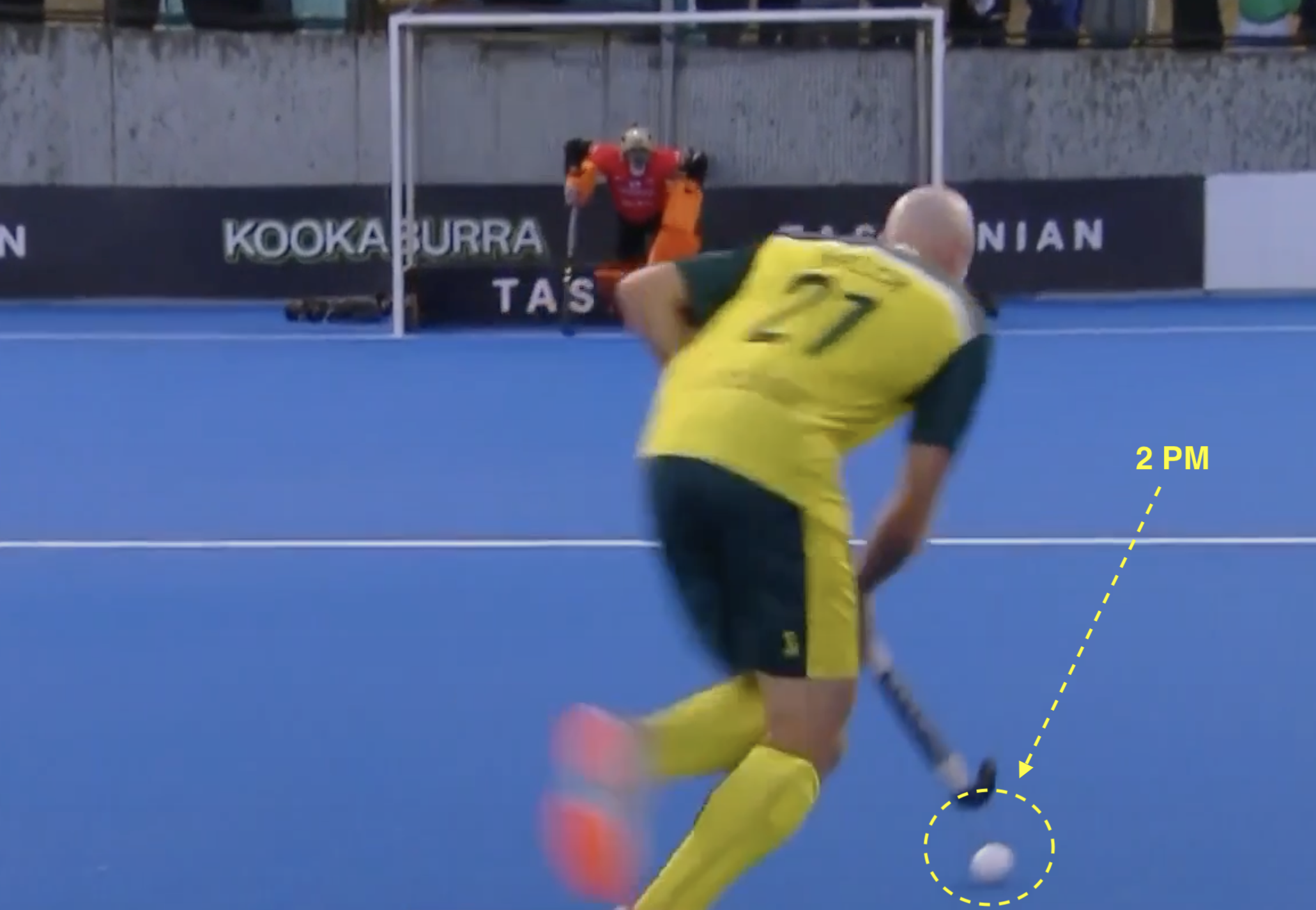
Welch starts with a standard carry on the right diagonal (diagonal carrying another fundamental we should pay attention to) at 2pm.

Very quickly he changes direction by moving his feet outside of the ball. Now he does change the ball direction with his stick here, but not with a pull. He is just pushing it along the new direction his feet are now moving, the ball now at 11am.
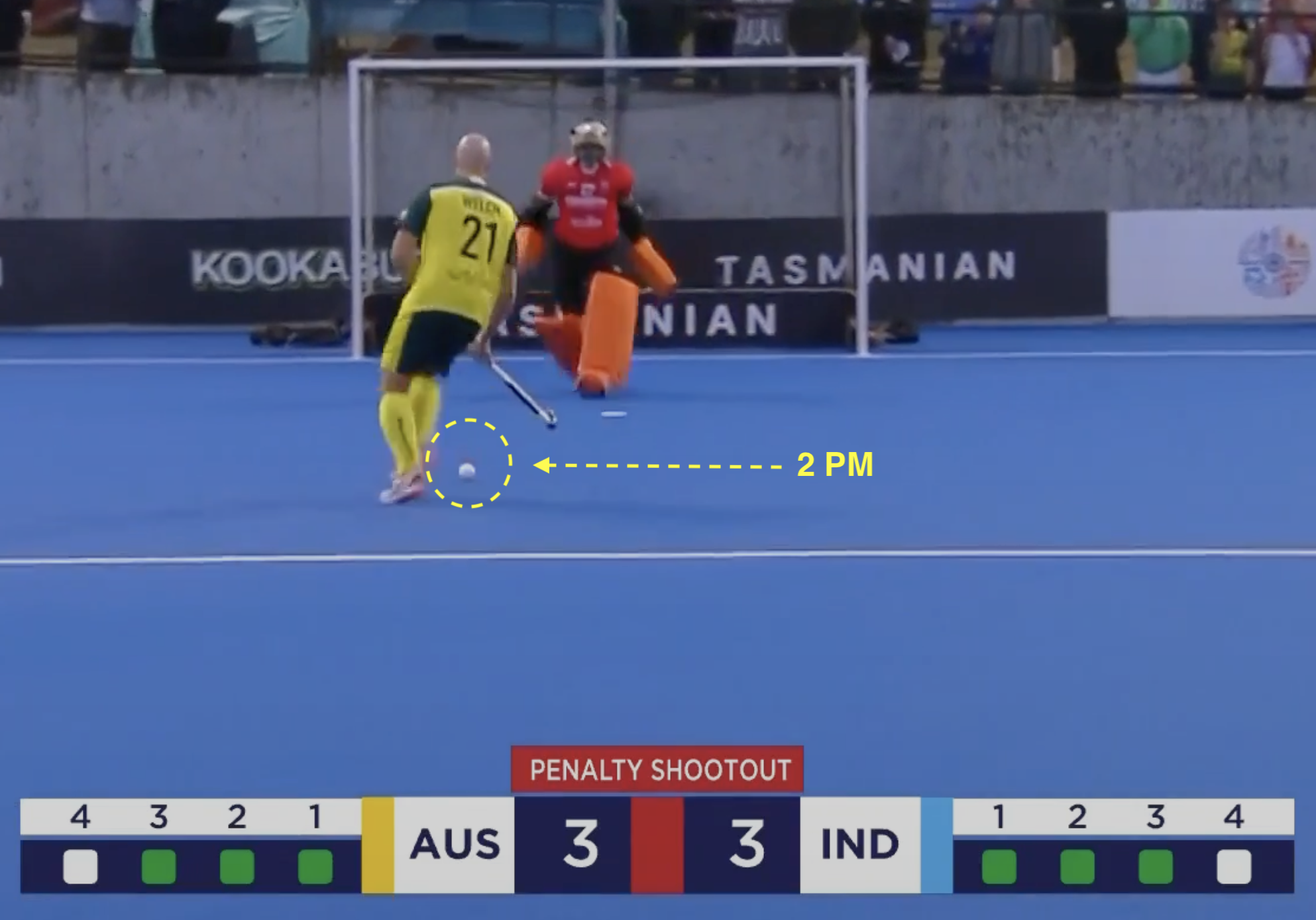
As he moves closer to goal, his feet move laterally again, switching back to a 2pm position. His stick has not touched the ball.
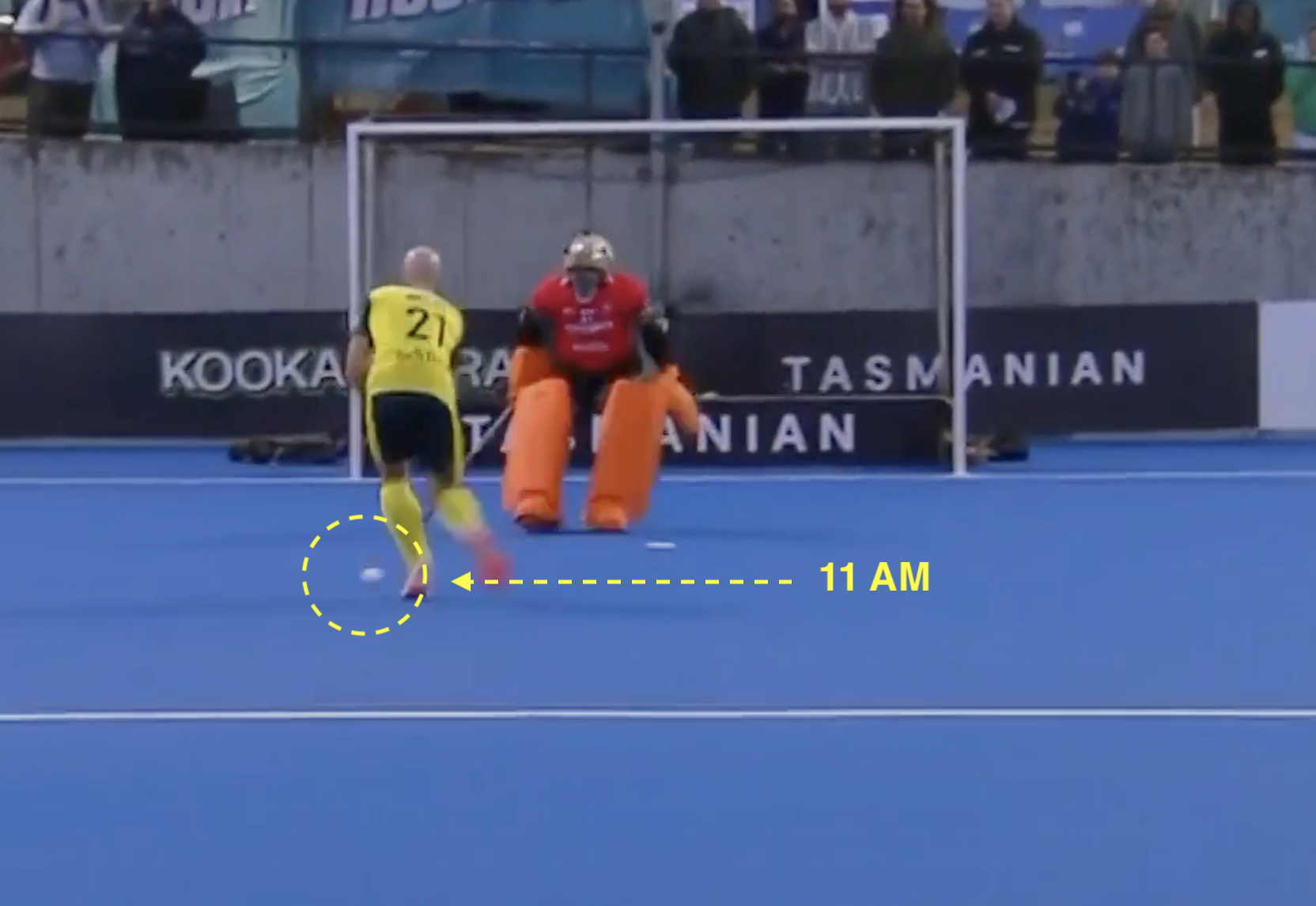
We keep watching and his feet change AGAIN. Back to 11am and only now is his stick starting to manipulate the ball.
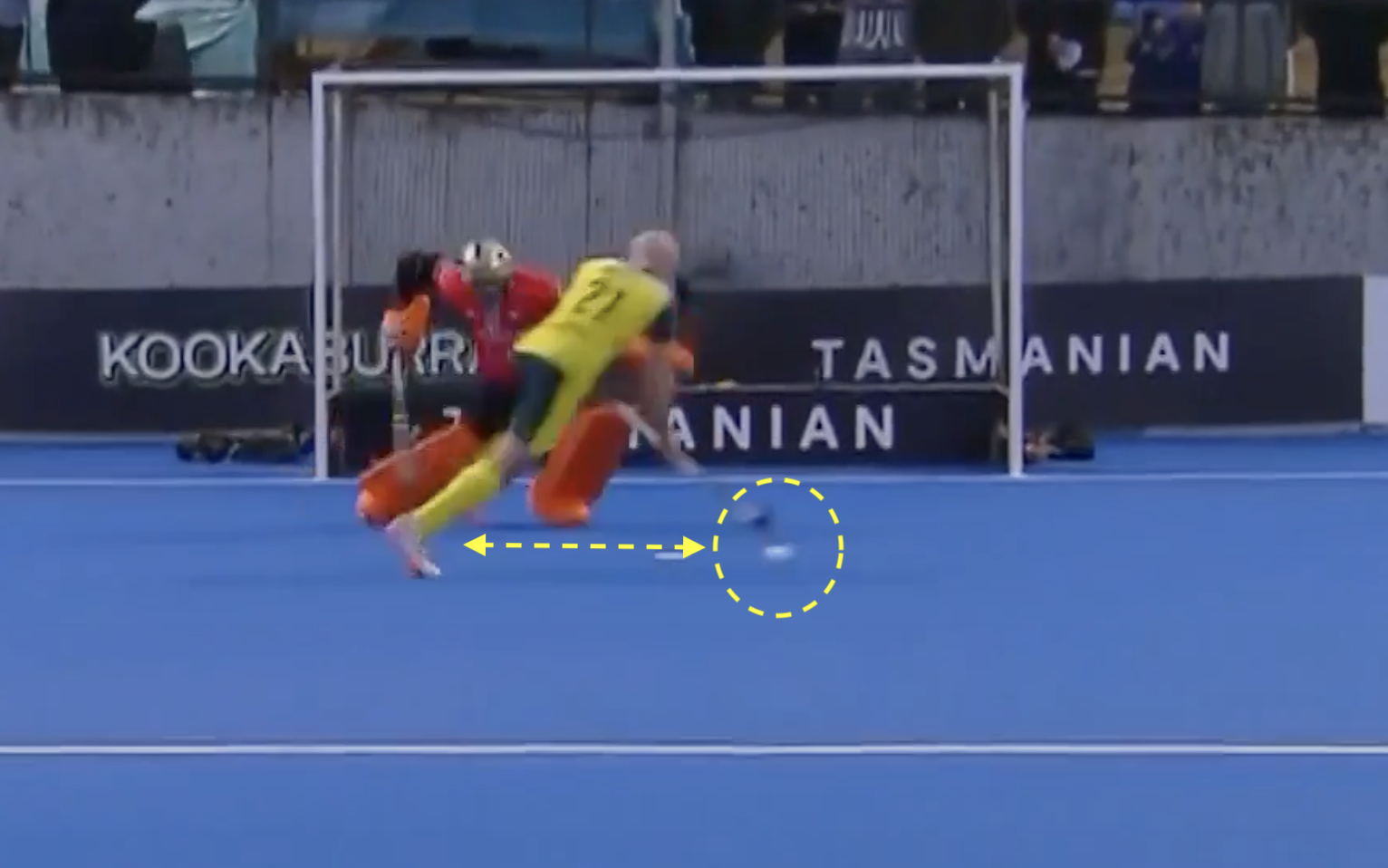
Finally, he drags / pulls the ball a wide distance from left to right. By this point the Goalkeeper is completely unbalanced and he has loads of space on the right to slot the ball into the goal.
Jack Welch moved his feet around the ball to create a different carry position FOUR TIMES in the space of 10 yards which explains why watching this in real time, it seems dizzying and also why trying to defend it would be the same.
Many players could move the ball from 2pm to 11am and back 4 times in this distance with their stick moving the ball and their feet and body staying in roughly the same line. The effect would be much less dramatic and much less effective, why?
Essentially and obviously, the body is much bigger than a hockey ball. And so seeing this amount of lateral body movement instead of lateral ball movement is much more disorienting for someone trying to keep up!
And this is the reason why, played back at full speed, this goal looks so great. I’m sure it’s why I was so much more drawn to this one than the other eight. I’m also sure it’s something we should really pay attention to when training our elimination skills. Yes we want fast hands to manipulate the ball, but fast feet that can move laterally like this, seem unstoppable!

Hi Adam,
It’s working!!!! Thanks for doing what you do. To Ross, too. Our girls are beginning to really apply their skills to the game & it was really evident this weekend. Everyone comments on their skills and I tell them it happens thanks to Leap & in our basement or messy toy room.
Just so grateful for this service that Leap provides as it makes field hockey much more fun for them!!